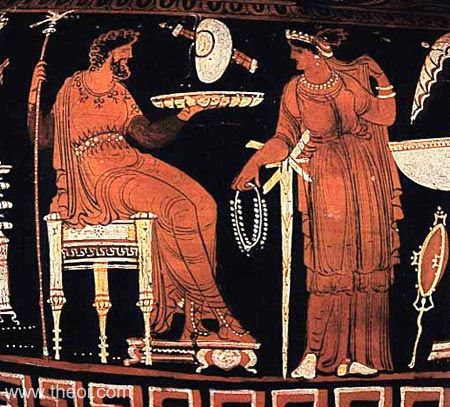
at Theoi Project I was browsing the page of Haides and came across an interesting part:
“Plato, Gorgias 523a ff (trans. Lamb) (Greek philosopher C4th B.C.) :
“Sokrates (Socrates) : Give ear then, as they say, to a right fine story, which you will regard as a fable, I fancy, but I as an actual account; for what I am about to tell you I mean to offer as the truth. By Homer’s account, Zeus, Poseidon, and Plouton (Pluton) [Haides] divided the sovereignty amongst them when they took it over from their father [Kronos (Cronus)]. Now in the time of Kronos there was a law concerning mankind, and it holds to this very day amongst the gods, that every man who has passed a just and holy life departs after his decease to the Isles of the Blest (Nesoi Makaron), and dwells in all happiness apart from ill; but whoever has lived unjustly and impiously goes to the dungeon of requital and penance which, you know, they call Tartaros. Of these men there were judges in Kronos’ time, and still of late in the reign of Zeus–living men to judge the living upon the day when each was to breathe his last; and thus the cases were being decided amiss. So Plouton [Haides] and the overseers from the Isles of the Blest came before Zeus with the report that they found men passing over to either abode undeserving. Then spake Zeus : ‘Nay,’ said he, ‘I will put a stop to these proceedings. The cases are now indeed judged ill and it is because they who are on trial are tried in their clothing, for they are tried alive. Now many,’ said he, ‘who have wicked souls are clad in fair bodies and ancestry and wealth, and at their judgement appear many witnesses to testify that their lives have been just. Now, the judges are confounded not only by their evidence but at the same time by being clothed themselves while they sit in judgement, having their own soul muffled in the veil of eyes and ears and the whole body. Thus all these are a hindrance to them, their own habiliments no less than those of the judged. Well, first of all,’ he said, ‘we must put a stop to their foreknowledge of their death; for this they at present foreknow. However, Prometheus has already been given the word to stop this in them. Next they must be stripped bare of all those things before they are tried; for they must stand their trial dead. Their judge also must be naked, dead, beholding with very soul the very soul of each immediately upon his death, bereft of all his kin and having left behind on earth all that fine array, to the end that the judgement may be just. Now I, knowing all this before you, have appointed sons of my own to be judges; two from Asia, Minos and Rhadamanthys, and one from Europe, Aiakos (Aeacus). These, when their life is ended, shall give judgement in the meadow at the dividing of the road, whence are the two ways leading, one to the Isles of the Blest (Nesoi Makaron), and the other to Tartaros. And those who come from Asia shall Rhadamanthys try, and those from Europe, Aiakos; and to Minos I will give the privilege of the final decision, if the other two be in any doubt; that the judgement upon this journey of mankind may be supremely just.’”
This is an interesting piece. This shows that before the appointment of Aiakos, Minos & Rhadamanthys as Judges of the Dead, there were others who did it before them. Only it is interesting to note that Zeus decided that all souls should be judged naked so that there would be no bias concerning the clothing of the souls. This would imply that before, the souls were judged but preferential treatment could be given to those in better clothing. I do wonder. Plouton/Ploutonas is another name for Aidoneos and sometimes He was also called Zeus Katakthonios and Zeus was also called Zeus Khthonios. Maybe I’m reading to much into it here and I’m being influenced here by Sannion’s view of many Dionysos’, that Plouton did not see Zeus as in Zeus, King of the Gods, but rather Zeus Katakhthonios, another name for Aidoneos, which could imply- that is- that Plouton/Ploutonas is either not another name for Aidoneos. But another God. Perhaps even another Aidoneos or Ploutonas was another God residing in the Underworld like Thanatos, Morpheos, Hypnos, Hekate, Acheron, Tartaros and over time people came to associate Plouton(as) with Aidoneos and started calling Him another name for Him instead of being a very different God. It is not uncommon. By the 5th century BC, Aidoneos had assimilated even Thanatos.
Still if there were other judges of the dead before the three: Aiakos, Minos & Rhadamanthys, I wander if there are any records of them bearing their names?
 Aidonian's blog
Leave a comment