TARTAROS
Tartaros was one of the first beings that emerged out of the creation of the universe, which personified the great stormy pit beneath the earth where the Titans were imprisoned. He was probably conceived of as a great solid dome similar to Ouranos (the Sky) but opposite to him and lying instead beneath the earth rather than above it.
The name was often used as a synonym of Haides the underworld. His name means Hell. The Latin name is Tartarus. His name is pronounced as tahr’-tuh-ruhs. Both Apollodorus as Hesiod are saying that Typhoeos is the son of Tartaros and Gaia. Hesiod also tells us how Typhoeos was conceived with the help of Aphrodite after the defeat of the Gigantes. But Hyginus Fabulae tells us that Tartaros begot by Tartara Typhon who was described as a creature with immense size and fearful shape, who had a hundred dragonheads springing from his shoulders. It is clear that Tartaros was not only the personification of Hell but the God of it ass well like the Underworld is called Hades but at the same time it is also the name of its God. This is a clear distinction made in the Theogony and later in all other myths where the name Tartaros shows up. Upon the fight between Zeus and Typhon Hesiod tells us that in his anger, he threw Typhon into Tartaros. It is said that if a anvil would fall into Tartaros from Heaven, it would take nine nights and days and upon the tenth day it would reach Tartaros. Round it runs a fence of bronze (which was made by Poseidon, and night spreads in triple line all about it like a neck-circlet, while above grow the roots of the earth and unfruitful sea. Walls runs all round it on every side and are the sources and ends of gloomy earth and misty Tartaros and the unfruitful sea and starry heaven, loathsome and dank, which even the gods abhor. It is a great gulf, and if once a man were within the gates, he would not reach the floor until a whole year had reached its end, but cruel blast upon blast would carry him this way and that. And this marvel is awful even to the deathless gods. The four Telchines are mentioned to be children of Nemesis and Tartaros or of Nemesis, the daughter of Tartaros. Apollodorus says that Tartaros was the places were Ouranos threw his children (the Cyclops and the Titans)) in and where Gaia told Zeus to find allies that would help him win the Titanomachia. While Hades is the main realm of the dead in Greek mythology, Tartarus also contains a number of characters. In early stories, it is primarily the prison for defeated gods; the Titans were condemned to Tartarus after losing their battle against the Olympian gods, and the Hekatonkheires stood over them as guards at the bronze gates. When Zeus overcomes the monster Typhus, born from Tartarus and Gaia, he hurls it too into the same abyss.
However, in later myths Tartarus becomes a place of punishment for sinners. It resembles Hell and is the opposite of Elysium, the afterlife for the blessed. When the hero Aeneas visits the underworld, he looks into Tartarus and sees the torments inflicted on characters such as the Titans, Tityos, Otus and Ephialtes, and the Lapiths. Rhadymanthus (and, in some versions, his brother Minos and in other version Minos, Rhadymanthys and Aeakas) judges the dead and assigns punishment.
Sources:
Apollodorus, The Library – Greek Mythography C2nd BC
Hyginus, Fabulae – Latin Mythography C2nd AD
Hesiod, the Theogony – Greek Epic C8th-7th BC
The Theoi Project
Harris, Stephen L. and Platzner, Gloria. Classical Mythology: Images and Insights. Sacramento: Mayfield Publishing Company, 1998, pp. 211-2.
Rose, H.J. A Handbook of Greek Mythology. New York: E.P. Dutton, 1959.
Homer. Odyssey. Book XI, 576 ff.
Vergil. The Aeneid. Book VI, 539-627.
HIMEROS:
Himeros was the ancient god of desire & one of the Erotes, were the ever-youthful winged gods of love or daimones of love. They were seen both as spirits and as Gods. The most famous of these were the frequently depicted triad of gods Eros, Himeros and Pothos. The Erotes were depicted as winged boys usually in the company of Aphrodite or her attendant goddesses.. He emerged at the very creation of the universe – a Protogenos (Primal deity) who represented the driving force of procreation in nature. When the newly born Aphrodite emerged from the sea, Himeros was the first god to welcome her and became her constant companion. Himeros was depicted as a winged youth, like the rest of the Erotes (Love-gods), despite his more ancient lineage. The name Himeros or Himerus as it is written in Latin means desire. Sometimes He is confused with Eros and is sometimes called Himeros- Eros but most of the time it is not done. Himeros is the God from whom we get the desire to something. Like someone’s desire to see his or her friend or relative again or to see ones partner again after a long period of time being separated. We can say allot of things about what we desire or desire in general but it comes from Himeros. He is not only the personification of desire but also the God of desire ass well. But on most occasions Himeros isn’t just the God of Desire but of Sexual Desire but here is He confused with Eros. The Theogony mentions no parents but the Halieutica does mentions Aphrodite or Khaos. On most occasions Himeros is mentioned as a companion to Aphrodite either as Eros, Himeros or both.
Sources:
The Theoi Project
Encyclopedia Mythica
THE NESOI:
The Nesoi are the personifications of the Islands itself. It was believed that they were once mountains but through Poseidon were cast into the sea by his trident. It was believed that each island had its own deity that personified the island and that their parents were Gaia and Ouranos. Callimachus tells us that each island had a deity that personified the island but that the island wasn’t named after its deity. So he tells us of Asteria, mother of Hekate who fled from Zeus, jumped into the sea and became the island of Delos. I think that the reference to daimon is justified here, that each island had a daimon (spirit) that was the patron/ matron of the island but that the story of Asteria becoming the island of Delos was added later.
Source:
The Theoi Project
THE OUREA:
The Ourea was seen as spirits of mountains and very few mountains were personified by spirits. It is said that they were bearded. The Theogony mentioned no father but Gaia as the mother. The names of the Ourea were Kithairon (Cithaeron) and Helikon (Helicon) of Boiotia, Tmolos (Tmolus- it was Him who was the judge in a musical contest between Pan and Apollo) and Olympos (Olympus- not the home of the Gods) from Phrygia and Aitna of Sicely( Aetna/ Etna, who gave birth to the Palikoi by hephaestos). A single Ourea was a Ouros and the name Ourea means mountains. Nonnos in his Dionysiaca tells us of the Kikilian mountain called Tauros who brayed a victorious noise after the defeat of Typhon. I think of them as i think of the Nesoi, that they are spirits/ Daimones.
Source:
The Theoi Project
AITHER:
Aithêr is the Protogenos of the Bright, Glowing, Upper Air. His name means Light/ Upper Air. His other name is Akmôn which means Untiring/ Anvil. There are two different spelling of his name. First the Latin one: Aether, Acmon and second the English: Ether. He is not only its God but also the personification of the upper air as opposed to the gloomy lower air of the Earth. His parents are Nyx and Erebos mentioned in the Theogony but Hyginus Pref mentioned Khaos as his parent. His mother Nyx (Night) drew the dark mists of Erebos across the sky beneath him to create night, while his sister Hemera (Day) drew away these mists to reveal his shining glow and bring the day. Night and day were regarded as independent of the sun in the ancient theogonies. He has several offspring but Hyginus seem to confuse him with Ouranos when saying that Aither has many children by Gaia. Hyginus is also our source for telling us that Aither is the father of Ouranos, Gaia and Thalassa by Hemera (his sister. But another source tells us that it is just Ouranos who is his child. And like Tartaros and Erebos, He too became the personification of his element and is mentioned in this way. In Hellas He might had shrines but no temples and probably no cult either. In the Orphic hymns, He is mentioned as the soul of the world from which all life emanates. As Akmon, Callimachus who calls Ouranos Akmonides is called him the father of Ouranos. Eustathius in Alcman tells us that the sons of Ouranos were called Akmonidai.
Sources:
Hesiod : The Theogony
Hyginus, Preface- Latin Mythography
Eustathius- Greek Lyric II Alcman
PONTOS:
Pontos or Pontus how it is written in Latin means Sea and is the God of the Sea as its personification. He is said to be the father of most of ancients of Sea Gods. Hesiod tells us that Gaia brought Him into the world with no help from a father but Hyginus says that Pontos’ parents were Aither and Gaia. Its also Hesiod and Apollodorus who say that Eurybia (Sea Goddess whose name means wide- force and She is the wife of the Titan Krios), Keto (whose name means sea monster and is a sea goddess/ daimone who personified the dangers and terrors of the sea and is married with Phorkys), Thaumas, Nereus and Phorkys are children of Gaia. But Hyginus says by Thalassa, Pontos fathered the fish and by Gaia Thaumas. In the Titanomachia, it is stated that Pontos is father of Aigaion (Aigaion was an alley of the Titans and after him the Aegean Sea was named after- the name itself means Aegean Sea or Goatish).) by Gaia and in the Bachylides it is stated that by Gaia He became father of the Telkhines. The Telkhines were magicians who later angered Zeus who cast them into the depths of the sea or into Tartaros. The name Telkhines means maligners. They were four mysterious magicians who were considered daimones of the sea. Pontos like most Sea Gods was more likely to be worshipped by seamen and fishers than people who were on the land.
Sources:
Hesiod, Theogony – Greek Epic C8th-7th BC
Greek Lyric IV Bacchylides, Fragments – Greek Lyric C5th BC
Apollodorus, The Library – Greek Mythography C2nd BC
Hyginus, Preface – Latin Mythography C2nd AD
THESIS:
THESIS was the personification of creation, and one of the oldest of the Protogenoi (first born gods). She was the first being to emerge and set into order the universe as the primeval deities came into being one by one: Khaos, Gaia, Erebos, Nyx and Hemera. She has another name: Thetis and both names mean Creation. Alcman is our only source for Her: “[First came] Thetis (or Thesis= Creation). After that, ancient Poros [=Khaos] and Tekmor’ [=Gaia]: Tekmor came into being after Poros .. Thereupon … called him Poros since the beginning provided all things; for when the matter began to be set in order, a certain Poros came into being as a beginning. So Alcman represents the matter of all things as confused and unformed. Then he says that one came into being [Thesis] who set all things in order, then that Poros came into being, and that when Poros had passed by Tekmor followed. And Poros is as a beginning, Tekmor like an end. When Thetis (Creation) had come into being, a beginning and end of all things came into being simultaneously, and all things have their nature resembling the matter of bronze, while Thetis has hers resembling that of a craftsman, Poros and Tekmor resembling a beginning and the end. He uses the word ancient for old. ‘And the third, Skotos’ ( Darkness) [=Erebos]: since neither sun nor moorn had come into being yet, but matter was still undifferentiated. So at the ssame moment there came into being Poros and Tekmor and Skotos. ‘Amar (Day) [=Hemera] and Melana (Moon) [=Selene] and third, Skotos as far as Marmarugas (= Flashings stars?)’: days does not mean simply day, but contains the idea of the sun. Previously there was only darkness, and afterwards, when it had been differentiated, light came into being.”
As Thetis, She is the Sea Goddess who gave birth to the hero Achilles by Peleus. The reason why She was wed to a mortal was for the fear of a son who will become more powerful than the father. This is why Zeus allowed this after He desired Her but was warned by Prometheus not having sex with Her. Another source tells us that it was Themis who made the prophecy. But this Thetis is not the same Thetis as the one whose name means creation. This Thetis is a Nereide, a daughter of Nereus. So these Goddesses might be confused with another plus that there is only source for the Goddess Thesis/ Thetis and that is one of a Greek Lyric dating back as the 7th century BC. She might have been honored but having a cult is something I have my doubts of.
Source:
Greek Lyric II Alcman, Fragments – Greek Lyric C7th BC
Homeros, Illiad
Apollonius Rhodius; Argonautica
THALASSA:
Thalassa is the female equivalent of Pontos and is a Sea Goddess herself. Her name also means Sea. Her parents are Aither and Hemera and by Pontos She begat the fishes, by Ouranos Aphrodite (the severed members of Ouranos) and Aigaion. She, like Pontos was seen as the personification of the sea. Thalassa, also known as Thalatta, Thalath, or Tethys is the Greek personification of the sea. Aither and Hemera were her parents. She¹s called the mother of Aphrodite by Zeus. She was the wife of Pontos and the mother of nine Telchines, who are known as fish children because they have flippers for hands; yet, they have the head of a dog. In some Greek stories, she is known as the mother of all. “Thalassa even goes by fish mother” This name is not only because she bore Telchines, it¹s also because she is creator of all sea life. Thalassa¹s name means ‘sea’. A mercantile sea kingdom is also associated with her name: Thalassocracy. In Greece, she is specifically the personification of the Mediterranean Sea. Thalassa did not have god-like qualities. She was more of a metaphor than a person. She was also a vast, lonely sea on non-populated shores. So, she was never a goddess. In most accounts, She is seen as the mother of most Leviathans and in the temples of Poseidon, that She too has a statue dedicated to Her.
Source:
The Theoi Project
HEMERA:
Hemera was the female personification of day and one of the Protogenoi (the first born elemental gods). She was married to her brother Aither (Light). Hemera is the Goddess of the Day. She is the daughter of Erebos and Nyx ‘Theogony 124). Alcman tells us that Erebos is the father of Hemera with no father suggesting a similar birth like the one Athena had. In Bacchylides it is stated that Nyx and Khronos are the parents but Hyginus mentions Khaos as the mother/ father. The name itself: Hemera means Day. She has other names like Amar or Dies which both of them mean Day. Dies is the Roman equivalent of Hemera. Hemera is the Latin spelling. The correct Greek spelling would be Hêmerê and means day. Hyginus is also our source when it comes to her offspring. He tells us that Ouranos, Gaia and Thalassa are her children with Aither. And like her brother and her parents, She is the personification of the Day. Pausanias seems to confuse Her with Eos when saying that She carried Kephalos away. Pausanias makes this identification with Eos upon looking to the tiling of the royal portico in Athens where the myth of Eos and Kephalos is illustrated. He makes this identification again at Amyklai and at Olympia upon looking at statues and illustrations where Eos (Hemera) is present.
Sources:
Pausanias, Guide to Greece – Greek Geography C2nd AD
Hyginus, Fabulae – Latin Mythography C2nd AD
Hesiod, Theogony – Greek Epic C8th-7th BC Greek Lyric II
Alcman, Fragments – Greek Lyric C7th BC Greek Lyric IV
Bacchylides, Fragments – Greek Lyric C5th BC
OKEANOS
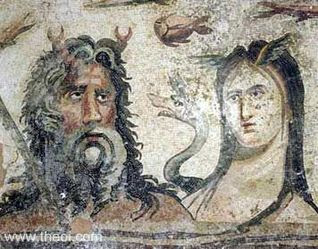
Okeanos is the Titan of the (River) Oceans. In Antiquity the oceans were seen as the rivers that surrounded the earth. He is the son of Gaia and Ouranos. This is certain as Hesiod, Apollodorus Rhodius and Diodolus Siculus all mention this. He is the source of fresh water, wells and rains. Unlike his siblings He was also a cosmological deity both as personification of the ocean as its manifestation. Like his sons, the River Gods, He was depicted as a Horned God with a tail of a serpentine fish. His name in Greek Ökeanos as his other name Ogenos mean ocean. He has two titles: Bathudine and Bathupous. Bathudine means Deep-Eddying. Bathupous mean Deep-Flowing.
The Theogony mentions the Okeanides and the Potamoi as the children of Okeanos by Tethys. Diodorus Siculus says that only the Potamoi are his children while the Cercopes says it are the Kerkopes by Theia, daughter of Memnon, who are his children. But Apollodorus tells us that Triptolemos who is his son by Gaia.
The Theogony tells us the entire cosmology of the Hellenes including the birth and offspring of Okeanos. Hesiod tells us also in his Theogony that on Okeanos’ advice, Styx came to Olympos to align herself with Zeus. Apollodorus tells us that not all the Titans attacked Ouranos. Only Okeanos stood aside when Gaia (Ge) persuaded the Titans to attack Ouranos. Tethys, the wife of Okeanos whom the Gods greatly revere, was the foster mother of Juno who on request of Juno forbade the constellation of the Bear to set in the Oceanus. (Hyginus Fab 177, Metamorphoses 2.512-547) When Palaemon jumped into the sea and became Glaucus, He called on Tethys and Oceanus to take away his mortal essences. (Metamorphoses 13.950-952)
The Dionysiaca states that after the slaughter of what they call the first Dionysos (Zagreus), Gaia was attacked by Zeus with avenging brand and he shut up the murderers of the horned Dionysos within the gate of Tartaros after a long war. Okeanos poured rivers of tears from his eyes and when Zeus claimed his wraith and pitied her, He washed away the wounds and ruins of the land with water in the flood of Deukalion. In the Dionysiaca it is said that Hera was afraid of Zeus whom She called Kronides for being banished from Heaven due a earthly marriage. She went to Tethys and Okeanos and than with to Ophion. The Iliad and the Homeric Hymns tell us that Okeanos was not only the place where the night sky came out of but also the place where the sun went under at the end of each day. It was also the place where Goddesses bath themselves. It is also said that at the end of the world, the entrance to the Underworld could be found and where the Gorgones and the Hesperides lived. It is even told in Aeschylus’ work: Prometheus Bound that Okeanos went to visit Prometheus in the Caucasus to talk to Prometheus. Okeanos seem to be the wisest and oldest of all the Gods and its no wonder that the Gods revered Him. His wisdom and his pacifistic attitude is what kept him out of trouble with the other Gods. I say pacifistic because to me, Okeanos doesn’t seem to come over as a violent Titan. Thanks to Jessy/ Arionssite I have a list of the Titans with their functions and attributes. For Okeanos this is the Water Element, Shape Shifting, Psychism, personification of the 6th month and Titan of the Water/ Sea. He has learned this over the years. And to be honest, it is one of the few things I don’t mind considering how little we know of the Titans.
Sources
Hesiod, Theogony – Greek Epic C8th-7th BC
Homerica, The Cercopes – Greek Epic BC
Homerica, The Cypria – Greek Epic BC
Homer, The Odyssey – Greek Epic C9th-8th BC
Homer, The Iliad – Greek Epic C9th-8th BC
The Homeric Hymns – Greek Epic C8th-4th BC
Aeschylus, Prometheus Bound – Greek Tragedy C6th-5th BC
Apollodorus, The Library – Greek Mythography C2nd BC
Diodorus Siculus, The Library of History – Greek History C1st BC
Ovid, Metamorphoses – Latin Epic C1st BC – C1st AD
Hyginus, Fabulae – Latin Mythography C2nd AD
Valerius Flaccus, The Argonautica – Latin Epic C1st AD
Nonnos, Dionysiaca – Greek Epic C6th AD
TETHYS:
Tethys is the Titaness of the Sea, Beaches, Islands, Fishing, Harbours. She created the coral and silver. She represents the 4th month. She is also the Titaness of Nursing and Underground Flow of Fresh Water. Married to Okeanos and mother of the Potamoi and the Okeanides. Her name Têthys means Nurse/ Grandmother/ Aunt. The pronounciation of her name is: thee’-thus. Her Roman name is Salacia. At the wedding, She is accompanied by Eileithyia, the Goddess of Childbirth. Tethys is usually depicted as a woman usually accompanied by Eileithyia, the Goddess of Childbirth due to be the mother of so many children. Hesiod gives her many names like Tethys the Lovely, Lady Tethys and Lovely- Haired Tethys. (Theogony) She is even called Fertile Tethys as reference to Her as the mother of so many children. (Prometheus Bound 139) She is like Okeanos seen as the personification of her element.
Hesiod, Apollodorus Rhodius as Diodorus Siculus seem to agree that Ouranos and Gaia are her parents but neither agree on who her children are. Hesiod mentions as Hyginus the Okeanides and the Potamoi. But Diodorus Siculus says it are only the Potamoi who are her children. She was even the foster mother of Hera (Juno) but I think this is truly Roman. That as Salacia, She was the foster mother of Juno. But I’m not sure about this. Salacia, a Roman sea goddess. The god Neptunus wanted to marry her but she ran off and hid from him in the Atlantic ocean. Neptune sent a dolphin to look for her and when the animal found her it brought her back to him. Salacia agreed to marry Neptune and the dolphin was awarded a place in the heavens. Salacia bore Neptune three children. She is identified with the Greek god, Amphitrite. But this can’t be true either. This could mean that Tethys and Okeanos were adopted deities who were adopted into the Roman pantheon as Tethys and Oceanus because they had no Roman counterparts.
Sources:
Hesiod, Theogony – Greek Epic C8th-7th BC
Aeschylus, Prometheus Bound – Greek Tragedy C6th-5th BC
Apollodorus, The Library – Greek Mythography C2nd BC
Diodorus Siculus, The Library of History – Greek History C1st BC
Hyginus, Fabulae – Latin Mythography C2nd AD
Elseviers Mythological Encyclopedia
 Aidonian's blog
Leave a comment