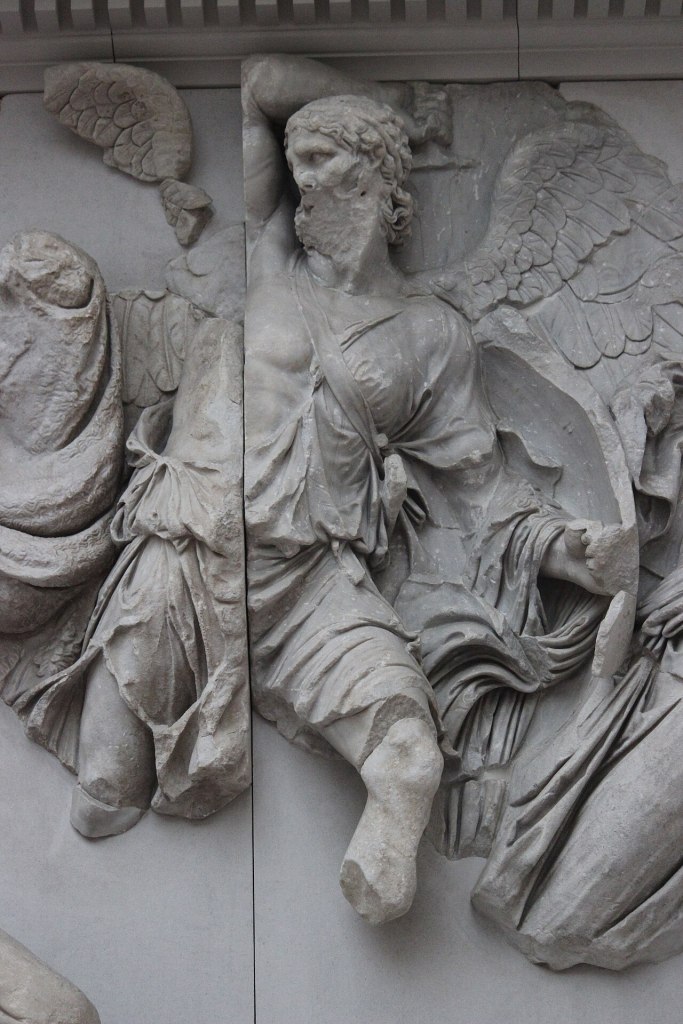
Ouranos is the primordial God of the Heavens and Sky. He is the personification of the sky and heavens. While He does not appear in any early Hellenic art, the ancient Greeks probably envisioned Him as a dome, placed over the Earth (Gaia). When Kronos castrated Him, He was described as a dome. Like with the other Protogenoi, He emerged from the creation of the universe, one can see Him as the universe itself.He emerged with the other Protogenoi from Khaos, the void. Together with Gaia, He fathered the first generation of Titans, the one-eyed Cyclopes, and the hundred-handed Hecatoncheires. When Kronos, his youngest son castrated Him, several other Gods came into being like Aphrodite and the Erinyes- later called the Eumenides. The Erinyes have been described as fathered by various Gods like Nyx & Erebos, Plouton and through Ouranos’ castration, a violent act that saw the emergence of the Erinyes in the universe itself. His name is Ouranos, but the Romans called Him Caelus or Uranus. The 8th planet is named after Him. Some say that He has different parents, some say that Gaia gave birth to Him without the use of a father. A not uncommon theme actually that a Goddess can give birth to a God without the help of another God.
Ouranos is the First ruler, the First King of the Universe before He passed it along to his son Kronos. He was the primordial King of the Universe along with Gaia.
Like with most Protogenoi, He is rather a abstract and distant cosmic deity. Its hard to fing a connection with sucha cosmic force. Its not impossible, but its not easy to do so. One can see Him as the part of the universe. If Khaos is the void between planets, Tartaros the Abyss that makes up the universe, than Ouranos is the dome that surrounds the universe. Not just for the universe but also for every planet that has a atmosphere. He and Gaia are Progenitors of divine races like Titans, Hekatonkheires, Cyclops, but also for the Olympians. Which makes Him a important figure. When Kronos castrated Him, the dome became more lose so life could flourish. Ouranos is the personification of the sky, the Heavens where the Gods have their abode according to the ancient authors, Zeus is the God of the Sky. This is not so uncommon. Helios and Selene are Titans of the Sun and Moon are more personifications of it, Apollon and Artemis are Gods of the Sun and Moon, among other things. The latter don’t represent the heavenly objects, but its part of their domain.
Epithets and Alternative Titles
Ancient poets and different religious movements used specific titles to describe his nature:
- Akmonides (Acmonides): A title meaning “Son of Akmon” (or “the untiring one”), used by the poet Alcman.
- Aion: In later Roman art, he was sometimes depicted as Aion, the god of eternal time.
- Kronotæknæ (Cronotecne): An epithet meaning “Father of Kronos”.
- Kozmokrátôr (Cosmocratôr): A title meaning “Lord of the World” or “ruler of the cosmos”.
- Panypǽrtatos Daimôn: Meaning “Highest and Most Exalted Divinity,” reflecting his status as a primordial Protogenos.
- Oria Noós: An Orphic term meaning “The Limits of Mind,” from which the English word “horizon” is partially derived.
Cult of Ouranos
To the best of my knowledge, Ouranos was not a God who reeived cultus in ancient Greece. He was seen as a vanquished God, similar to Kronos, but unlike Kronos. Ouranos was also seen as a force of nature like with most Protogenoi. Which makes sense that He did not receive any cultus except for invoked as an oath as He is a God who like Helios and Zeus, sees all. In the Orphic mystery tradition, He does play a role and even has a Orphic hymn where it is stated that He received offerings of frankinscence as traditional fumigation. He is respecter as Progenitor of the Titans and Olympian Gods, the First King of the Universe. People leaning towards philosophy or Orphici and cosmologically might honour Him and give Him offerings. Reconstructionists might not honour and woship Him directly, but indirectly through the Titans as He is their Father or through the Olympians as He is their grandfather. The hymn to Ouranos is a beautiful one, like most Orphic hymns.
How to worship Ouranos:
In ancient Greece, Ouranos (Uranus) was rarely worshipped as an independent deity because he was viewed as the physical personification of the sky rather than a responsive personality. He had no formal temples, feast days, or established cults.
For modern practitioners (Hellenists) who wish to honor him, worship typically follows the general structure of Greek Ouranic (celestial) ritual.
Core Ritual Practices
- Prayer Posture: Stand with your palms facing upward toward the sky while reciting prayers out loud.
- Purification: Wash your hands and face (a practice known as khernips) before beginning to remove everyday “dirt” or spiritual impurity.
- Sacred Space: While traditional altars are rare, rituals are best performed under the open sky, on mountaintops, or in open fields to connect with his celestial nature.
- Hymns: Recite the Orphic Hymn to the Sky, which addresses him as the “father of all” and “lord of the universe”.
- Primary Ancient Epithets
- Asteras (Starry/Stars): This refers to Ouranos as the “Starry Sky” (Ouranos Asteras), emphasizing his role as the vault containing the constellations.
- Panypǽrtatos Daimôn (The Most Exalted Divinity): Found in Orphic hymns, this title describes him as the highest and most fundamental consciousness.
- Akmonides (Son of Akmon): In some traditions, Ouranos is given this patronymic, though “Akmon” (meaning “anvil” or “tireless”) is often used as a name for the sky itself rather than a separate father.
- Father of All (Genitor): The Orphic hymns address him as the primeval beginning of all things, both gods and men.
- Abode of the Happy Gods: He is referred to as the foundation or home where the divine beings reside.
- Descriptive Titles & Attributes
- The Bronze Sky-Dome: Hesiod describes Ouranos as a solid, tireless bronze dome that stretches over the Earth.
- World-Enveloper: He is characterized as a sphere that moves around the Earth, enveloping all celestial and terrestrial things.
- The Oracular Voice: Some myths suggest Ouranos (often alongside Gaia) acted as an early oracular power, warning Cronus and Zeus about their future downfalls.
Offerings to Ouranos
As an Ouranic deity, offerings are traditionally sent upward (e.g., through smoke) rather than poured into the ground.
- Incense: Frankincense, myrrh, or juniper are common choices as the smoke wafts toward the heavens.
- Libations: Water, milk, or wine can be poured onto the ground or a dedicated offering bowl.
- Items: Stones like lapis lazuli (often called “sky stone”) or objects with celestial symbols (stars, zodiacs) are modern associations.
Important Symbolism
- Associations: He represents the infinite cosmos, starry night sky, and the creation of order.
- Visual Symbols: In art, he is sometimes shown as a majestic man holding a zodiac wheel over Gaia (Earth).
- Divine Role: He is the father of the Titans, Cyclopes, and Hecatoncheires.
Great Ouranos, whose mighty frame no respite knows, father of all, from whom the world arose; hear, bounteous parent, source and end of all, for ever whirling round this earthly ball; abode of gods, whose guardian power surrounds the eternal world with ever during bounds; whose ample bosom, and encircling folds the dire necessity of nature holds. Ethereal, earthly, whose all-various frame, azure and full of forms, no power can tame. All-seeing source of Kronos, for ever blessed, deity sublime, propitious on a novel mystic shine, and crown his wishes with a life divine.
source
The Theoi project Ouranos page
 Aidonian's blog
Leave a comment