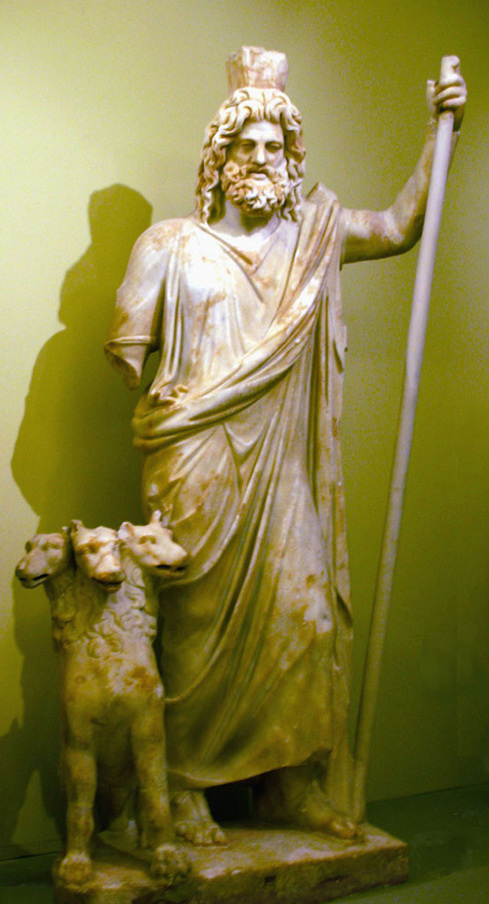
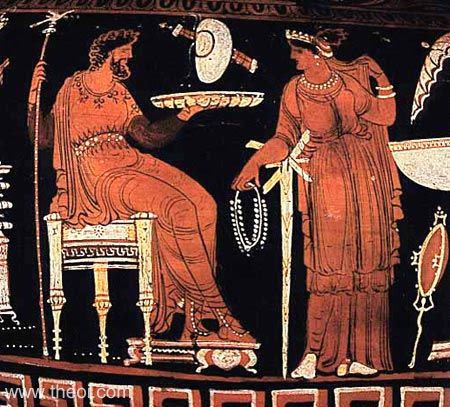
Aidoneos, the God of the Underworld is a God with many faces. At one point he became one with Death, so people were afraid to speak his name (Aidoneos) out of fear of calling Him out to drag you to Hades – another name for the Underworld).
Aidoneos is an Olympian but also a Khthonic God. Next to Hermes, He is one of the few who can cross the border between Heaven and the Underworld. It is believed that going to the world of the Dead taints you, even a God, so only Gods with earthly or Khthonic aspects could go there. The Others weren’t allowed to.
This is also applied to people dealing with the dead, in the sense that they have to take care of the dead, bury them. They have to purify themselves afterwards or risk tainting themselves and perhaps others. I think this comes from the fear that the dead carry diseases and that they sought to purify them so they wouldn’t spread anything. In a time where medical science isn’t as it is today, people could easily die from diseases where we have cures for today. So it doesn’t surprise me that people feared death and wanted to avoid it as long as possible. This is still true today as it true for all living things really. The thing is, death is inevitable. It’s part of life.
Aidoneos might be represented as a stern God, but He should be stern and strict. Everyone would beg to postpone it, trying to persuade the God from protecting him from the end.
He might come off as stern, but He is also merciful. While a person might beg to have his or hers life not ending, when someone is in pain and is suffering, they also don’t want to die, but the thing is, death releases them from their suffering, their pain. As I experienced it recently with my cat Simba, letting a human or animal needles suffering is cruel and inhumane. In that sense He is merciful.
Is Aidoneos the God of Death then?
The answer is no. That is Thanatos. Thanatos is a son of Nyx and the personification of Death itself. He appears in the myth of Sisyfos where the king was able to capture Thanatos after He appears to take him to Tartaros on behest of Zeus. While the Moirai decide the fates of mankind, when they are born, how their lives look like, and their death, the Gods can alter the threads of destiny. Late in antiquity Aidoneos (Haides) became syncretised with Thanatos, even though they are two distinct Gods. Aidoneos is the Lord and Ruler of the Underworld with all its tenants, including ghosts, Daimones, monsters and various Underworld Gods. This is no different for Poseidon being the Ruler of the Seas and all its tenants, spirits, monsters and Gods. This means that Aidoneos is not the one who fetches souls and brings them to the Underworld, but rather that it is Hermes Psychopompos and Thanatos who do that. He can send them to fetch someone, but that would stepping in the domain of the Moiraie and Zeus. No God would do that without Zeus’ consent. This also means Aidoneos would not intervene in the deaths of people. He can not be persuaded to hold of Thanatos, but He can perhaps be persuaded to be kind to the person who is dying and who is crossing over to the Underworld. I think that is the only thing you can do. That is, if you are lucky enough.
Is Aidoneos an evil God?
The answer is again no. While being ruler over the Underworld might draw up connotations like with Satan/Lucifer ruling over Hell, it is not the same. Aidoneos is Ruler of Underworld, which also includes the Elysian fields (Heaven) and Tartaros (Hell: sorth of). Aidoneos is not evil. While it is easy to portray a God with this kind of domain as such, its rather simplistic to say the least to say that all Gods of Underworld are evil. While they can be responsible for bad things, it doesn’t make them evil. The concept of evil, or the existence of something that personifies evil, as the one responsible for all the bad things that happen, does not really exist in Hellenic polytheism, nor in Roman polytheism. Why? Because they saw that humans are responsible for the bad things that happen in life, not one being. There was a God of sickness, but He was called upon for the diseases to be averted or to be cured, where they also call upon Paeon Apollon for that.
What are his any names or Titles?
-
Aidês Kyanokhaites: “Haides with the Dark hairr.”
-
Aidês Adiaulos: “ No Way Back”
-
Aidês Ameilikhos: “ He Who is Relentless”
-
Aidês Adamastos: “ The Inflexible One”
-
Aidês Damazo: “The Overpowering One”; “He who tames”; “ to bring under the yoke”; “ to make (or to be made) subject to another”; “ the Seducer” ; “ the Subduer ”; “ to conquer ”; “ to strike dead” – Ennykhos: “He Who Dwells in the Realm of the Night and the Dead.”
-
Enertera Theos: “ God of the Netherworld”
-
Aidês Eukles: “Famous One”; “ Glorious One”; “ Of Good Repute”
-
Aidês Euthynos: “The Corrector”; “The Chastiser”; “He Who Judges”.
-
Hesperos Theos: “God of Darkness and Death.”
-
Aidês Klymenos: “The Renowned”; “The Noble”; “The Splendid.”
-
Aidês Kyamites: “He of the Bean” – Melamphaes: “One whose Light is Blackness”
-
Aidês Melanopteros: “The Black Winged” – Oudaios/ Oudas: “The Infernam One”; “Of the
Earth”; “Beneath the Earth.” – Philoxenos: “He Who is Hospitable to Strangers.”
-
Aidês Polydektes/ Polydegmon: “The All-Receiving”
-
Aidês Polydektes ‘Receiver of Many’
-
Aidês Polydegmôn () ‘ He Who Receives Many’
-
Aidês Pylartes: “The Closer of Gates”
-
Aidês Clymenus/Klymenous () ‘the Illustrious, notorious’
-
Zeus Khthonios (‘Zeus of the Underworld)’
-
Aidês Polysêmantôr ( ‘Ruler of Many)
-
Theôn Khthonios () ’God of the Underworld)
-
Ploutôn (Ploutwn) ‘Of Wealth’
-
Aidês Euboleus/ Euboulos ‘Good Counselors’
-
Aidês Isodetês ‘Impartial’
-
Aidôneus (the real name of Haides)
God of the underworld
Aidôneos is the God of the underworld and wealth. The reason why he also the God of the
Wealth is related to Ploutonas / Plouton/Pluto; which can be translated as rich
or wealth. Traditionally, the Earth was considered as a source of wealth. Gold, iron,
things they take out of the ground. That’s why Aidôneos is associated with it.
Traditionally, all the gods that are khthonic, or Earth gods were associated with
wealth. Most of them.
Aidôneos is primarily the God of the underworld. He’s the king of
Underworld gods, Daimones and the dead. Supreme god of the Gods of the underworld. He is the “Zeus”; of the underworld as Zeus commands in heaven and Poseidon “Zeus”; is of the sea. Aidôneos rarely left the Underworld (which was called Hades). Rarely, the Gods to him. Only Dionysus, Herakles, Hermes and Hekate have visited the underworld. and leave again. It didn’t really have anything to do with them avoiding him on purpose. The ancient Greeks saw death as something unclean, like some kind of miasma, they had to purify themselves. Only certain people were also allowed to work with the dead. Death was something they feared and
thought people in the area were unclean.
It is a fact that khthonic; had a double meaning for the Greeks. On the one hand
it was associated with death and unclean things. On the other hand,”khthonic”; also
associated with human and Earth fertility. Guthrie in his book refers to a
old theory that formerly separated with “khthonisch” the two things (fertility and death) were each other’s. The merger would have been created by Demeter Guthrie here refers to an old theory that the khthonic gods were only associated with death and not death. The introduction of Demeter brought about a slow change in the situation and began to to see fertility of the land and death together in one context. [5]
The name Plouton or Pluto reveals that Aidôneos is also the God of wealth and protects them. Hesiodos would have recommended praying to khthonic Zeus or pure Demeter to protect his or influence harvest. The name khthonic Zeus would originally be a
regional name, thanks to the universalism of the Olympic pantheon before
made it start popping up everywhere. Even spirits were bound to wealth, that
they were even included as titles or first names for Zeus, such as Trophonios or Amphiaraos.
God of necromancy
That Aidôneos was associated with dark magic practices such as necromancy is in itself
not so strange. All the Gods of the underworld are associated with all kinds of magic.
The most famous of all the gods associated with this is Hekate; the
Goddess of Magic, Underworld, Heaven, Earth, Sea and Moon.
All gods can be summoned in the magic rituals. It is certainly not limited to the
Gods of the underworld. Aidôneos and his wife Persephone are the Gods
others were also associated with necromancy, conjuring up spirits and were
responsible for the oracles of the dead.
He was invoked by mostly witches when they wanted to summon spirits. Usually there is only one reason people want to summon ghosts of dead people: treasures. It is not recommended that said ghosts know where hidden treasures are. It is also said that as spirits being called to serve as oracles, they can predict the future.
Far from the oracles of the dead are nekromantic in nature. That’s why there was an altar to be found. for Haides and Persephone, who watched over nekromantic practices.
God of curses, Lord of the Erinyen
As we shall also see at Hekate, Aidôneos was called upon to swear, especially the one where the vengeful Erinyen were summoned. As Lord and Master of the Erinyen,
according to some the father of the Erinyen, he was called to the Erinyen (Eumenides) in force and control as far as possible. In some cases Erinyen sent out to join a vengeful spirit in their attempt to retaliate.
Master Of Dreams
The Gods Morpheus and Hypnos reside in the Hades (Underworld), and are therefore more or less
subordinate to the Aidôneos. You have ordinary dreams and dreams that were sent by
Daimones and Gods. Especially with regard to the one before last, Aidôneos had something to stir.If a dream was supposed to have been sent by a spirit or another supernatural being like a God came from the Hades. The gate of two doors of Dreams (The One contains the truth, the other contains lies) is in Aidôneos.
God of Earthly fertility
Aidôneos was considered a god of the fertility of the Earth, since he
Persephone returned to her mother Demeter of his dark, underground domain. In
then you see him holding a cornucopia.
That’s not Strange in itself. Life and death have always gone hand in hand. Without the
death would make life unbearable. We mortals want eternal life. We forget
well, without death, there would be a life where there is no end. Someone mortally wounded hit couldn’t die, so then couldn’t get out of his misery, because
there is no death. If you look for example at volcanic eruptions. They’re hugely devastating, but providing new land, fertility.
 Aidonian's blog
Leave a comment