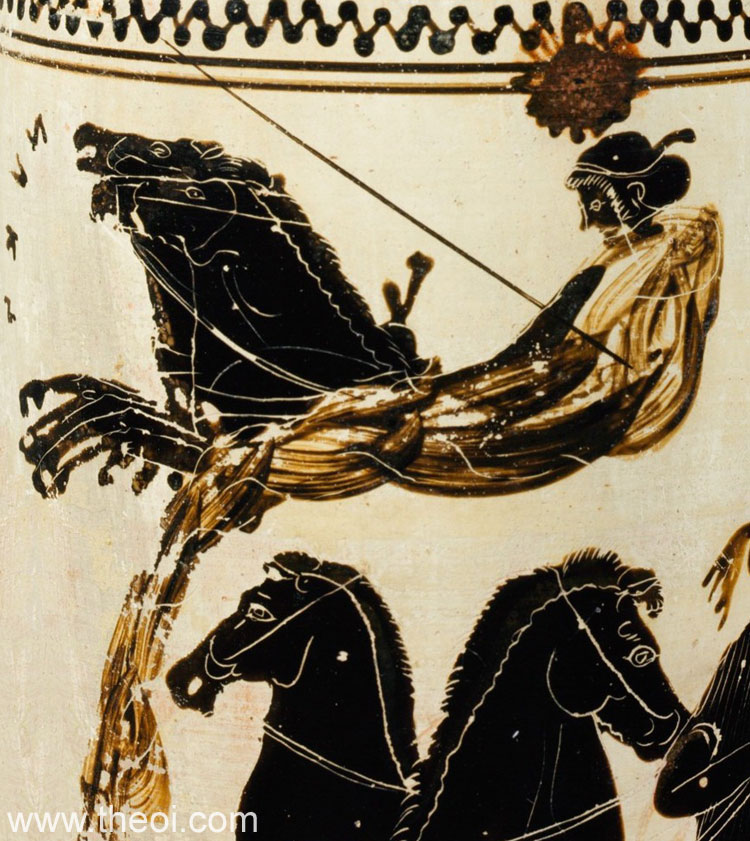
Nyx is the primordial goddess of the Night, and progenitor of many deities and spirits. She is the wife of Erebos, the God of Darkness. From them, came forth the Hemera (Day) and Aether (Light). When the sun sets, Nyx and Erebos came from the Underworld to bring forth night and darkness and They go back to the Underworld when the sun is about the rise again. Nyx was worshipped by early Orphici and She even had statues in temples of other Gods as well, but no temple dedicated to Her is mentioned. Since She is part of the primordial deities, its rare to find temples to Them. She is also associated with withcraft. Its because of Her that we can rest during the night, that we can find peace and sleep. She brought forth the Oneiroi, the personifications of dreams, but also terrors as well. She send them to mankind to help us process the events of the day. I always found that the night is quieter, tranquility. In myth she doesn’t play a significant role, but sailors prayed to Her to find their way home. However when Hera asked Hypnos to send Zeus in a deep sleep so She could wreak havoc to Herakles, Zeus was angry and chased Hypnos. When He found him, he immediately backed off. He sought refuge with His mother Nyx. Even Zeus, who is the most powerful God of the Hellenic pantheon didn’t dare to go against Her. Which says alot. If even the King of the Gods is affraid of Her, what does it say? In my opinion, this means that Nyx was held in high regard, higher than Hekate, that even Zeus wouldn’t dare to anger Her. While some authors regard Her as a dangerous deity, She has other facets. While the night hold many terrors and dangers, its also brings calm, peace, tranquility, sleep.
Cult of Nyx
In the region of Megaris, the city of Megara had an temple dedicated to Dionysos Nyktelios, which also had a sanctuary of Aphrodite Epistrophia and an oracle of Nyx. It is even suggested that the oracle of Delphi belonged at one point to Nyx before it was transferred to Themis, Gaia, and Apollo. Pausanias writes the following in his “Description of Greece in the 2nd century AD:
“When you have ascended the citadel [of Megara], which even at the present day is called Karia (Caria) from Kar (Car), son of Phoroneos, you see a temple of Dionysos Nyktelios (Nyctelius, Nocturnal), a sanctuary built to Aphrodite Epistrophia (She who turns men to love), an oracle called that of Nyx (Night) and a temple of Zeus Konios (Dusty) without a roof. The image of Asklepios and also that of Hygeia (Health) were made by Bryaxis. Here too is what is called the Chamber of Demeter, built, they say, by Kar when he was king.”
In the 1st century AD Ovid wrote the following: “May 9 Lemuria Nefastus. You ancient rite will be performed, Nox (Night) Lemuria; here will be offerings to the mute dead.”The Lemuria is the Roman festival where malevolent spirits were exercised through ritual. The fact that Nox (Nyx) was invoked here shows her kthonic aspect and her connection to the Hades. Which made sense really if you think about. Night is associated with dark side of human experience. As She was also associated with witchcraft, she was invoked during witchcraft as we will see later on. Some sources claim that Nyx was the mother of Hekate, most likely those who made the associated with Hekate, so it would be easier to connect Her to witchcraft through Hekate.
Statius in his Thebaid epic wrote the following: “O Nox (Night) . . . Ever shall this house throughout the circling periods of the year hold thee high in honour and in worship; black bulls of chosen beauty shall pay thee sacrifice [black animals were sacrificed to the chthonic gods], O goddess! And Vulcanus’ [Hephaistos’] fire shall eat the lustral entrails, where-o’er the new milk streams.”
Nyx & witchcraft
Ovid writes the following: “When she [Luna-Selene the Moon] shone in fullest radiance . . . [the witch] Medea . . . went forth alone upon her roaming way, in the deep stillness of the midnight hour . . . Then to the stars she stretched her arms, and thrice she turned about and thrice bedewed her locks with water, thrice a wailing cry she gave, then kneeling on the stony ground, ‘O Nox (Night) [Nyx], Mother of Mysteries, and all ye golden Astra (Stars) . . . and thou, divine three-formed Hecate . . . and thou, kindly Tellus (Earth) [Gaia], who dost for magic potent herbs provide . . . and Gods of Night (Di Omnes Noctis), be with me now! By your enabling power, at my behest . . . the deep earth groan and ghosts rise from their tombs. Thee too, bright Luna (Moon) [Selene], I banish, though thy throes the clanging bronze assuage; under my spells even my grandsire’s [Sol-Helios the Sun’s] chariot grows pale and Aurora (Dawn) [Eos] pales before my poison’s power.’”
Ovid, Metamorphoses 10. 403 ff”
Here Ovid connects the Goddesses associated with the night like Nyx, Selene (the moon) and Hekate with the famous witches Medea and Kirke. But not just Goddesses, but also Gods like Plouton and Erebos are invoked during witchcraft.
“She [the witch Kirke (Circe)] sprinkled round about her evil drugs and poisonous essences, and out of Erebos and Chaos called Nox (Night) and the Gods of Night (Di Nocti) and poured a prayer with long-drawn wailing cries to Hecate. The woods (wonder of wonders!) leapt away, a groan came from the ground, the bushes blanched, the spattered sward was soaked with gouts of blood, stones brayed and bellowed, dogs began to bark, black snakes swarmed on the soil and ghostly shapes of silent spirits floated through the air.”
In late Antiquity authors focused primarly on her darker side just like with Plouton, Persephone, Hekate were the cases. For me its unclear as to why that is. Is it because of poetic licenses? It is for dramatic effect? Or was it because some authors were more conservative and didn’t like women who had powers? Or it could be al of them? One thing is clear: it were only the Roman poets who focussed on Her terrifying nature.
Nyx in theology
One myth where Themis delivers the prophecy that the son born to Thetis will be greater than his father and will supplant Him was given to Zeus and Poseidon when they both pursued the Nereid. Later sources like Libanus (4th century AD) state it wasn’t Themis who deliverd this prophecy but Nyx. In the Illiad Hera goes to Hypnos to ask for his help, but He recounts that last time He helped Her so She could persecute Herakles, Zeus was so angry, He almost threw Him in the sea, if Hypnos did not hide with his mother Nyx, whom Zeus dared not cross.Nonnus in his Dionysiaca wrote that it was Iris in the form of Nyx when She went to Hypnos to ask Him to put Zeus to sleep.
Some suggested that Nyx even played a role in the Titanomachia and Gigantomachia where She was identified on a relief fighting Giants.
I. THE COSMOGONY OF HESIOD
Hesiod, Theogony 115 ff (trans. Evelyn-White) (Greek epic C8th or C7th B.C.) :
“Verily at first Khaos (Chaos, the Gap) [Air] came to be, but next wide-bosomed Gaia (Gaea, Earth) . . . and dim Tartaros (the Pit) in the depth of the wide-pathed Earth, and Eros (Love), fairest among the deathless gods, who unnerves the limbs and overcomes the mind and wise counsels of all gods and all men within them.
From Khaos (Chaos) [Air] came forth Erebos (Erebus, Darkness) and black Nyx (Night); but of Nyx (Night) were born (Aether, Bright Upper Air) and Hemera (Day), whom she conceived and bore from union in love with Erebos.
And Gaia (Gaea, Earth) first bore starry Ouranos (Uranus, Heaven), equal to herself, to cover her on every side.”
Bacchylides, Fragment 7 (trans. Campbell, Vol. Greek Lyric IV) (Greek lyric C5th B.C.) :
“Radiant daughter [Hemera the Day] of Khronos (Chronos, Time) and Nyx (Night).”
Orphic cosmogony
Aristophanes, Birds 685 ff (trans. O’Neill) (Greek comedy C5th to 4th B.C.) :
“At the beginning there was only Khaos (the Chasm) [Air], Nyx (Night), dark Erebos (Darkness), and deep Tartaros (the Pit). Ge (Gaea, Earth), Aer (Air) [probably Aither (Aether) the upper air] and Ouranos (Uranus, Heaven) had no existence. Firstly, black-winged Nyx (Night) laid a germless egg in the bosom of the infinite deeps of Erebos (Darkness), and from this, after the revolution of long ages, sprang the graceful Eros [the primordial Eros] with his glittering golden wings.”
Orphic Hymn 7 to the Astron (trans. Taylor) (Greek hymns C3rd B.C. to 2nd A.D.) :
“Celestial Astra (Stars), dear progeny of Nyx (Night).”
Orphica, Argonautica 12 ff (trans. West) (Greek hymns C3rd – C2nd B.C.) :
“Firstly, ancient Khaos’s (Chaos’) stern Ananke (Inevitability), and Khronos (Chronos, Time), who bred within his boundless coils Aither (Aether, Light) and two-sexed, two-faced, glorious Eros [Phanes], ever-born Nyx’s (Night’s) father, whom latter men call Phanes, for he first was manifested.”
Orphica, Theogonies Fragment 101 – 102 (from Proclus) (trans. West) (Greek hymns C3rd – C2nd B.C.) :
“[Phanes] placed his distinguished sceptre [the rulership of the universe] in the hands of goddess Nyx (Night), that she hold royalty . . . [Nyx] holding in her hands the glorious sceptre of Erikepaios (Ericepaeus) [Phanes].”
Orphica, Theogonies Fragments (from the Deveni Papyrus) :
“Zeus, when from his father the prophesied rule and strength in his hands he took and the glorious daimon . . . . the god [Phanes] who first sprang forth into the Aither (Aether, Light).
Kronos (Cronus) who did a mighty deed to Ouranos (Uranus, Sky), son of Nyx (Night), who became king first of all; following him again Kronos (Time), and then Zeus the contriver.”
Nonnus, Dionysiaca 31. 115 ff (trans. Rouse) (Greek epic C5th A.D.) :
“The ugly form of Hypnos’ (Sleep’s) mother the blackgirdled goddess Nyx (Night) . . .
[Iris disguised as Nyx addresses Hypnos :] ‘O Blackwing! Do not provoke Gaia (Earth), my [Nyx’s] father’s [Khaos’] agemate, from whom alone we are all sprung, we who dwell in Olympos.’”
Nyx is more present in the Orphic theology than with the standard theology. She seems to have been considered the first deity in the earliest known Orphic cosmogonies like with Homeros and Hesiodos, she was thought to be the First. The oldest Orphic theogony in which She is known to have appeared is the Eudemian Theogony (5th century BC), which receives its name from the philosopher Eudemus of Rhodes, a student of Aristotle, who spoke of an Orphic theogony in one of his works; this theogony was later referred to by the Neoplatonist Damascius, in his De Principiis (On First Principles), using Eudemus as his source.The only piece of information known for certain about this theogony is that it started with Nyx.
Because of this, it has been proposed that Night, presumably on her own, is described as the mother of Ouranos and Gaia in the work;West takes this further, claiming that Night is the mother of Uranus and Gaia, and that they are the parents of Okeanos and Tethys, who produced the Titans. In the Derveni Theogony (4th century BC), an Orphic poem known through the commentary on the work found in the Derveni papyrus, Nyx appears to have been the first deity;according to Bernabé, she exists eternally before the creation of the cosmos, at a time when the universe sits in a state of “cold and passive darkness”.In a surviving line from the poem, quoted in the Derveni papyrus, she is described as the mother of Ouranos
In the poem, Night was called the “immortal nurse of the gods” (as quoted in the Derveni papyrus),and in its narrative she nurtures and gives shelter to the young Zeus.Later in the work, after Zeus overthrows his father Cronus and becomes king, he consults Night on how he can consolidate his rule.She is described as she “who knows all the oracles”, and delivers a prophecy to him from within her shrine (adyton); several reconstructed lines from the work describe this:
And Zeus [… came to the cave, where]
Night sat, immortal nurse of the gods, knowing all oracles
… to prophesy from the innermost shrine.
She prophesied all that it was permitted him to achieve,
how he would hold the lovely seat in snowy Olympus.
After Zeus receives this prophecy from Night (and one from his father Cronus), he apparently swallows either the phallus of Uranus (or, as other have suggested, the body of Phanes).
The role which Night plays in the Derveni Theogony has been compared to that which Gaia plays in Hesiod’s Theogony.It has pointed out that both are described as the mother of Uranus, and occupy a similar position at the beginning of creation, with Gaia being the second being to exist in the Theogony.In addition, following the creation of world, rather than becoming rulers themselves, both deities remain present and occasionally offer guidance and assistance to younger generations.The prophecy which Night delivers to Zeus, which causes him to swallow Phanes, has been compared to the prophecy Gaia and Ouranos report to Zeus in the Theogony, which leads him to swallow his wife Metis. In the Theogony, Zeus is also given to Gaia after his birth, which has been connected to the role Nyx plays in nurturing the young Zeus in his infancy.
This is actually interesting to read that both Nyx and Erebos played a different role to the younger generations of Gods where They guided Them and at times even nursed Them like They did with Zeus. Especially Nyx played the nurse for several other deities. In Orphic theology She seemed to have played a larger role than with other theologies where She is only mentioned being there at the beginning and rarely playing any role in the myths. As i started out this month, I was already fascinated bt Nyx and Erebos and delving into them deeper has made the fascination only bigger.
My final thoughts on Nyx are that She is definitly worth it to spend more time on Her and I hope this helps to spread more awareness of Her and how amazing She is. Nyx and Erebos are two deities that you can easily see in the real world as They are also the personfication of night and darkness. When looking at the darkness of space, you can see Erebos, but also Nyx. When the sun sets and night comes, its Them that you can see.
I haven’t found much on how to honour Her properly, but i use a Orphic hymn when praying to Her and offering libation of water and dragon blood incense. I also do that for Her husband Erebos.
epithets
Primary Epithets and Descriptive Titles
- Starry-Eyed (Asteroömmatos): Highlights the stars that pepper the night sky, showing that even in her darkness there is light.
- Subduer of Gods and Men (Dmetira theon kai andron): A title from Homer’s Iliad, emphasizing her absolute power to bend even the highest divinities to her sway.
- Black-Winged (Melanópteros): Refers to her frequent depiction in art and poetry as a winged figure soaring through the sky.
- Nurse of the Gods (Trophós): An Orphic title describing her as a nurturing figure who provides rest and counsel to the younger generations of gods, including Zeus.
- Chaos-Born (Khaosgenetor): Reflects her lineage as one of the first beings to emerge from the primordial void (Chaos).
- Kindly/Cheerful (Euphrone): A euphemistic title used by the Greeks to placate her potentially dangerous nature, similar to calling the Furies the “Kindly Ones”.
Orphic and Mystical Titles
In the Orphic mystery cults, Nyx held a supreme position, often viewed as the first or second ruler of the cosmos.
- Mother of All: Addressed in Orphic hymns as the progenitor of both gods and men.
- Prophetic Goddess: Unlike Apollo, who rules day-lit oracles, Nyx was believed to give secret, unerring prophecies from a cave at the edge of the world.
- Kypris: Curiously, some Orphic hymns apply this title (usually reserved for Aphrodite) to Nyx to denote her generative, mothering power.
- Oldest of All: A title used in the proem of the Orphic Hymns to establish her seniority over all other existence.
Sources:Physical and Elemental Attributes
Poets often described her appearance using specific elemental adjectives:
Night-Revealing (Nyktelios): Often associated with her role in “bringing” or “revealing” the night; this title was also shared with Dionysus in certain nocturnal cults
Erebennē: Dark or shadowy, derived from her association with the underworld darkness of Erebus.
Kelainē / Mélaina: Standard Greek terms for “black” or “gloomy,” emphasizing the literal absence of light.
Ambrosial (Ambrosíē): Divine and fragrant, used to describe the “holy” quality of the nighttime air.
 Aidonian's blog
Leave a comment