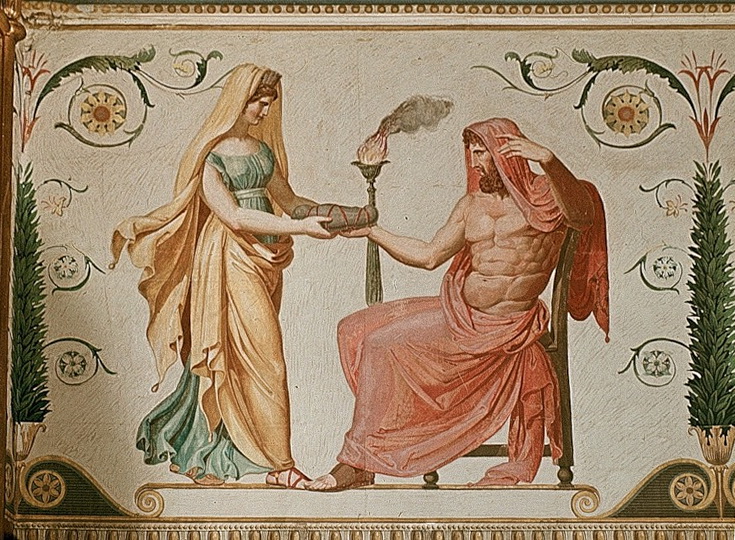
Saturnalia is an ancient Roman festival and holiday in honour of the god Saturn, held on 17 December of the Julian calendar and later expanded with festivities through to 23 December. The holiday was celebrated with a sacrifice at the Temple of Saturn, in the Roman Forum, and a public banquet, followed by private gift-giving, continual partying, and a carnival atmosphere that overturned Roman social norms: gambling was permitted, and masters provided table service for their slaves as it was seen as a time of liberty for both slaves and freedmen alike.A common custom was the election of a “King of the Saturnalia”, who gave orders to people, which were followed and presided over the merrymaking. The gifts exchanged were usually gag gifts or small figurines made of wax or pottery known as sigillaria. The poet Catullus called it “the best of days”.
Saturnalia was the Roman equivalent to the earlier Greek holiday of Kronia, which was celebrated during the Attic month of Hekatombaion in late midsummer. It held theological importance for some Romans, who saw it as a restoration of the ancient Golden Age, when the world was ruled by Saturn. The Neoplatonist philosopher Porphyry interpreted the freedom associated with Saturnalia as symbolizing the “freeing of souls into immortality”. Saturnalia may have influenced some of the customs associated with later celebrations in western Europe occurring in midwinter, particularly traditions associated with Christmas, the Feast of the Holy Innocents, and Epiphany. In particular, the historical western European Christmas custom of electing a “Lord of Misrule” may have its roots in Saturnalia celebrations.
Who is Saturn?
Saturn or Kronos is the father of the Olympian Gods Zeus, Poseidon, Plouton, Hera, Demeter and Hestia but known under the Latin names Jupiter, Neptune, Dis Pater, Juno, Ceres and Vesta. While the worship of Saturn is most likely older than the syncronisation with Kronos, in Roman myths He was known as the ruler of the Italian people under a Golden Age where people knew no sorrow, no pain or death.
The Saturnalia reflects the contradictory nature of the deity Saturn himself: “There are joyful and utopian aspects of careless well-being side by side with disquieting elements of threat and danger.”
As a deity of agricultural bounty, Saturn embodied prosperity and wealth in general. The name of his consort Ops meant “wealth, resources”. Her festival, Opalia, was celebrated on 19 December. The Temple of Saturn housed the state treasury (aerarium Saturni) and was the administrative headquarters of the quaestors, the public officials whose duties included oversight of the mint. It was among the oldest cult sites in Rome, and had been the location of “a very ancient” altar (ara) even before the building of the first temple in 497 BC.
The Romans regarded Saturn as the original and autochthonous ruler of the Capitolium,[and the first king of Latium or even the whole of Italy.At the same time, there was a tradition that Saturn had been an immigrant deity, received by Janus after he was usurped by his son Jupiter (Zeus) and expelled from Greece.His contradictions—a foreigner with one of Rome’s oldest sanctuaries, and a god of liberation who is kept in fetters most of the year—indicate Saturn’s capacity for obliterating social distinctions.
Roman mythology of the Golden Age of Saturn’s reign differed from the Greek tradition. He arrived in Italy “dethroned and fugitive”,but brought agriculture and civilization and became a king. As the Augustan poet Virgil described it:
“[H]e gathered together the unruly race [of fauns and nymphs] scattered over mountain heights, and gave them laws … . Under his reign were the golden ages men tell of: in such perfect peace he ruled the nations.”
This contradictory views is not uncommon in polytheistic traditions. Today I started observing this festival for the first time where I honoured Kronos under the name of Saturn. For me, Saturn is Kronos, so I observe both the Saturnalia as the Kronia. I kept it to one day because in a couple of day Heliogenna festival start, that I also observe and doing two festivals is a bit much if you ask me.
Those who observe it, can do it by changing the roles at home, work, etc… if possible. Since I’m alone and only have a cat as a pet, it is difficult so I chose to do it by burning incense to Kronos and reading a Orphic hymn to Him.
source:
wikipedia on Saturnalia
 Aidonian's blog
Leave a comment