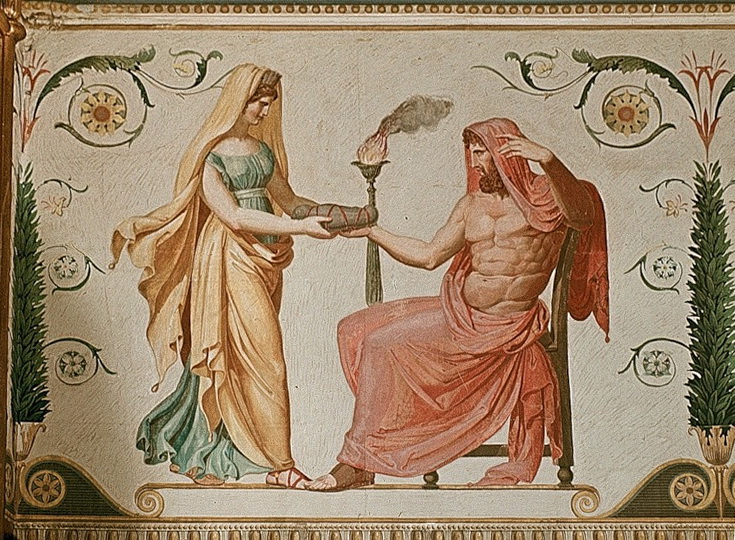
In Ancient Greek religion and mythology, Kronos (/ˈkroʊnəs/ or /ˈkroʊnɒs/, from Greek: Κρόνος, Krónos) was the leader and youngest of the first generation of Titans, the divine descendants of the primordial Gaia (Mother Earth) and Ouranos (Father Sky). He overthrew his father and ruled during the mythological Golden Age, until he was overthrown by his own son Zeus and imprisoned in Tartarus. According to Plato, however, the deities Phorcys, Kronos, and Rhea were the eldest children of Oceanus and Tethys.
Kronos was usually depicted with a harpe, scythe or a sickle, which was the instrument he used to castrate and depose Ouranos, his father. In Athens, on the twelfth day of the Attic month of Hekatombaion, a festival called Kronia was held in honour of Kronos to celebrate the harvest, suggesting that, as a result of his association with the virtuous Golden Age, Kronos continued to preside as a patron of the harvest. Kronos was also identified in classical antiquity with the Roman deity Saturn.
Only Kronos was willing to do the deed, so Gaia gave him the sickle and placed him in ambush. When Ouranos met with Gaia, Kronos attacked him with the sickle, castrating him and casting his testicles into the sea. From the blood that spilled out from Ouranos and fell upon the earth, the Gigantes, Erinyes, and Meliae were produced. The testicles produced a white foam from which the goddess Aphrodite emerged. For this, Ouranos threatened vengeance and called his sons Titenes for overstepping their boundaries and daring to commit such an act. After the deed was done, Kronos cast his sickle into the waves, and it was concealed under the island of Corfu, which had been noted since antiquity for its sickle-like shape, and gave it its ancient name, Drepane (“sickle”).
While Hesiod seems to imply Kronos never let them free to begin with, Pseudo-Apollodorus says that after dispatching Ouranos, Kronos re-imprisoned the Hecatoncheires and the Cyclopes and set the dragon Campe to guard them. He and his older sister Rhea took the throne of the world as king and queen. The period in which Kronos ruled was called the Golden Age, as the people of the time had no need for laws or rules; everyone did the right thing, and immorality was absent. In some authors, a different divine pair, Ophion and Eurynome, a daughter of Okeanos, were said to have ruled Mount Olympus in the early age of the Titans. Rhea fought Eurynome and Kronos fought Ophion, and after defeating them they threw them into the waves of the ocean, thus becoming rulers in their place.
Sibylline Oracles
Kronos is mentioned in the Sibylline Oracles, particularly in book three, wherein Kronos, ‘Titan,’ and Iapetus, the three sons of Uranus and Gaia, each receive a third of the Earth, and Kronos is made king overall. After the death of Uranus, Titan’s sons attempt to destroy Kronos’ and Rhea’s male offspring as soon as they are born. However, at Dodona, Rhea secretly bears her sons Zeus, Poseidon, and Hades and sends them to Phrygia to be raised in the care of three Cretans. Upon learning this, sixty of Titan’s men then imprison Kronos and Rhea, causing the sons of Kronos to declare and fight the first of all wars against them. This account mentions nothing about Cronus either killing his father or attempting to kill any of his children.
Libyan account by Diodorus Siculus
In a Libyan account related by Diodorus Siculus (Book 3), Ouranos and Titaea were the parents of Kronos and Rhea and the other Titans. Ammon, a king of Libya, married Rhea (3.18.1). However, Rhea abandoned Ammon and married her younger brother Kronos. With Rhea’s incitement, Kronos and the other Titans made war upon Ammon, who fled to Crete (3.71.1–2). Kronos ruled harshly and Kronos in turn was defeated by Ammon’s son Dionysos (3.71.3–3.73) who appointed Kronos’ and Rhea’s son, Zeus, as king of Egypt (3.73.4). Dionysos and Zeus then joined their forces to defeat the remaining Titans in Crete, and on the death of Dionysos, Zeus inherited all the kingdoms, becoming lord of the world (3.73.7–8).
Release from Tartarus
In Hesiod’s Theogony, and Homer’s Iliad, Kronos and his Titan brothers are confined to Tartarus, apparently forever, but in other traditions Cronus and the other imprisoned Titans are eventually set free by the mercy of Zeus. Two papyrus versions of a passage of Hesiod’s Works and Days mention Kronos being released by Zeus, and ruling over the heroes who go to the Isle of the Blessed; but other editions of Hesiod’s text make no mention of this, and most editors agree that these lines of text are later interpolations in Hesiod’s works.
And they live untouched by sorrow in the islands of the blessed along the shore of deep swirling Ocean, happy heroes for whom the grain-giving earth bears honey-sweet fruit flourishing thrice a year, far from the deathless gods, and Kronos rules over them; for the father of men and gods released him from his bonds.
The poet Pindar, in one of his poems (462 BC), wrote that although Atlas still “strains against the weight of the sky … Zeus freed the Titans”,and in another poem (476 BC), Pindar has Kronos released from Tartarus and now ruling in the Isles of the Blessed, a mythical land where the Greek heroes reside in the afterlife:
Those who have persevered three times, on either side, to keep their souls free from all wrongdoing, follow Zeus’ road to the end, to the tower of Cronus, where ocean breezes blow around the island of the blessed, and flowers of gold are blazing, some from splendid trees on land, while water nurtures others. With these wreaths and garlands of flowers they entwine their hands according to the righteous counsels of Rhadamanthys, whom the great father, the husband of Rhea whose throne is above all others, keeps close beside him as his partner.
Prometheus Lyomenos (Prometheus Unbound), an undated lost play by the playwright Aeschylus (c. 525 – c. 455 BC), features a chorus composed of freed Titans as witnesses of Prometheus’ freeing from the rock, perhaps including Kronos himself, although the now freed Titans are not individually identified.
Other accounts
In one version of Typhon’s origins, after the defeat of the Giants, Gaia in anger slandered Zeus to Hera, and she went to Kronos. He gave his daughter two eggs smeared with his own semen and told her to bury them underground, so that they would produce a creature capable of dethroning Zeus. Hera did so, and thus Typhon came to be.
Kronos was said to be the father of the wise centaur Chiron by the Oceanid Philyra, who was subsequently transformed into a linden tree.The god consorted with the nymph, but his wife Rhea walked on them unexpectedly; in order to escape being caught in bed with another, Kronos changed into the shape of a stallion and galloped away, hence the half-human, half-equine shape of their offspring; this was said to have taken place on Mount Pelion.
Two other sons of Kronos and Philyra may have been Dolops and Aphrus, the ancestor and eponym of the Aphroi, i.e. the native Africans. In some accounts, Kronos was also called the father of the Corybantes.
Kronos is featured in one of the works of satirical writer Lucian of Samosata, Saturnalia, where he talks with one of his priests about his festival Saturnalia, with a central theme being the mistreatment of the poor by the rich during festival-time.In the dialogue, Cronus rejects the Hesiodic tradition of him eating his children and then being overthrown, and instead claims that he peacefully abdicated the throne in favour of his youngest son Zeus, although he still resumes rulership for seven days each year (his festival) in order to remind humanity of the plenteous, toil-free and luxuriant life they enjoyed under his reign before the Olympians took over.
Other names & Titles
Kronos has been identified with Saturn, the Roman version of Kronos. But also with the Phoenician El Olam. In Mesopotamian pântheons He was also called Ninurta and Enlil. The ancient Egyptians called Him Geb.Dont confuse Him with Khronos, the protogenos of time, he was different deity although later the two merged, which was not uncommon in polytheistic religions.
His epithets were :
Kronodaimohn – (Cronodaemon; Gr. Κρονοδαίμων, ΚΡΟΝΟΔΑΙΜΩΝ) = Κρόνος.
Krouown ton Noun – (Gr. Κρούων τον Νοῦν) he who strikes the mind.
Pikilómythos – (poicilomythus; Gr. ποικιλόμυθος, ΠΟΙΚΙΛΟΜΥΘΟΣ) of various discourse.Over time (no pun intended here) He became associated with the Protogenos Khronos, the personification of Time itself. ankylomêtēs; Crooked Counseling. This distinctive epithet highlights Cronus’ wily but cruel nature.
Cult of Kronos
Kronos did have a cult. Pausanias makes mention of temples and shrines to the Titan in places like Lebedaia, Olympia, Athens, etc… It is said that the Olympian games were first dedicated to Kronos before Zeus took over.
Symbol: scythe, snake, grain
incense: storax
Orphic Hymn to Kronos
Krónos [ Κρόνος] [
The Fumigation from Storax.
Etherial father, mighty Titan, hear,
Great sire [19] of Gods and men, whom all revere:
Endu’d with various council, pure and strong,
To whom perfection and decrease belong.
Consum’d by thee all forms that hourly die,
By thee restor’d, their former place supply;
The world immense in everlasting chains,
Strong and ineffable thy pow’r contains;
Father of vast eternity, divine,
O mighty Saturn, various speech is thine:
Blossom of earth and of the starry skies,
Husband of Rhea, and Prometheus wise.
Obstetric Nature, venerable root,
From which the various forms of being shoot;
No parts peculiar can thy pow’r enclose,
Diffus’d thro’ all, from which the world arose,
O, best of beings, of a subtle mind,
Propitious hear to holy pray’rs inclin’d;
The sacred rites benevolent attend,
And grant a blameless life, a blessed end.
I compiled this post using information I found on wikipedia, Theoi Project and Hellenic Gods.org. I hope you enjoyed it and learn more about Him. I didn’t know the epithets so I was pleasantly surprised to find that out.
 Aidonian's blog
Leave a comment