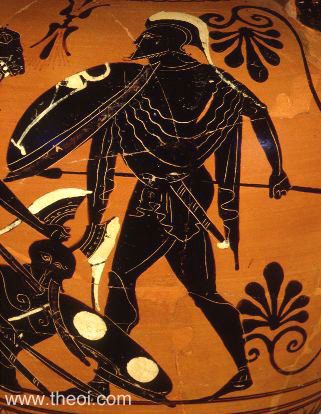
Homeric hymn to Ares
Ares, exceeding in strength, chariot-rider,
golden- helmed, doughty in heart, shield-bearer,
Saviour of cities, harnessed in bronze, strong of arm,
unwearying, mighty with the spear,
O defence of Olympus,
father of warlike Victory,
ally of Themis,
stern governor of the rebellious,
leader of righteous men,
sceptred King of manliness,
who whirl your fiery sphere among the planets in their sevenfold courses through the aether wherein your blazing steeds ever bear you above the third firmament of heaven;
hear me, helper of men,
giver of dauntless youth!
Shed down a kindly ray from above upon my life, and strength of war, that I may be able to drive away bitter cowardice from my head and crush down the deceitful impulses of my soul.
Restrain also the keen fury of my heart which provokes me to tread the ways of blood-curdling strife. Rather, O blessed one, give you me boldness to abide within the harmless laws of peace, avoiding strife and hatred and the violent fiends of death.
Orphic hymn to Ares
Magnanimous, unconquered, boistrous Ares,
in darts rejoicing, and in bloody wars
Fierce and untamed, whose mighty power can make the strongest walls from their foundations shake:
Mortal destroying king, defiled with gore,
pleased with war’s dreadful and tumultuous roar:
Thee, human blood, and swords, and spears delight,
and the dire ruin of mad savage fight.
Stay, furious contests, and avenging strife,
whose works with woe, embitter human life;
To lovely Aphrodite, and to Dionysos yield, to Demeter
give the weapons of the field;
Encourage peace, to gentle works inclined, and give abundance, with benignant mind.
analysis of the hymns
at first glance, the Homeric hymn is more biased towards Ares than the Orphic one, focussing on the positieve side of the God. The Orphic hymn also mentions his positieve side, but also mentions his negative, his destructive side, something we do not see show in the Homeric ones. Ares is the God of War, battelust, Courage and civil order as Theoi Project states it. Which makes sense that the Romans viewed Mars, the Roman equivalant of Ares as their most important God next to Jupiter Optimus Maximus. History shows us that many Greek city states went to war with each other but also viewed civil order, courage as important The thing is, that these things also overlap with other Gods like Pallas Athena and Zeus. Which is not so uncommon with Gods to have their domains overlap with each other at times.
While the Homeric hymn mentions his relationship with Themis and Nike, the Orphic hymn does not but references his relationship with Aphrodite and Dionysos. Something the Homeric hymn does not mention at all. After all, in the myths, Ares and Aphrodite are lovers until caught by Hephaestos in a net.
The Homeric hymn emphasizes the positive traits of Ares, while the Orphic one also highlights the more darker traits of war like the brutality of war, the bloodshed. The Homeric one focusses on that Ares represented manliness, strength, courage, the savior of cities and ally of Themis, while He could also be the destroyer of cities as well. Both hymns highlghts the view the worshippers had of the God. He was more than the savage bloodthirsty war god he is shown to be in myths and popular media. Which is not uncommon because how the Gods are portrayed in myths and popular media does not reflect at all how the worshippers saw them. Ares like Herakles and Athena can be called upon to drive away the cowardice in men’s hearts, help people defeat evil and give people the courage to continue fighting even when it seems hopeless.
 Aidonian's blog
Leave a comment