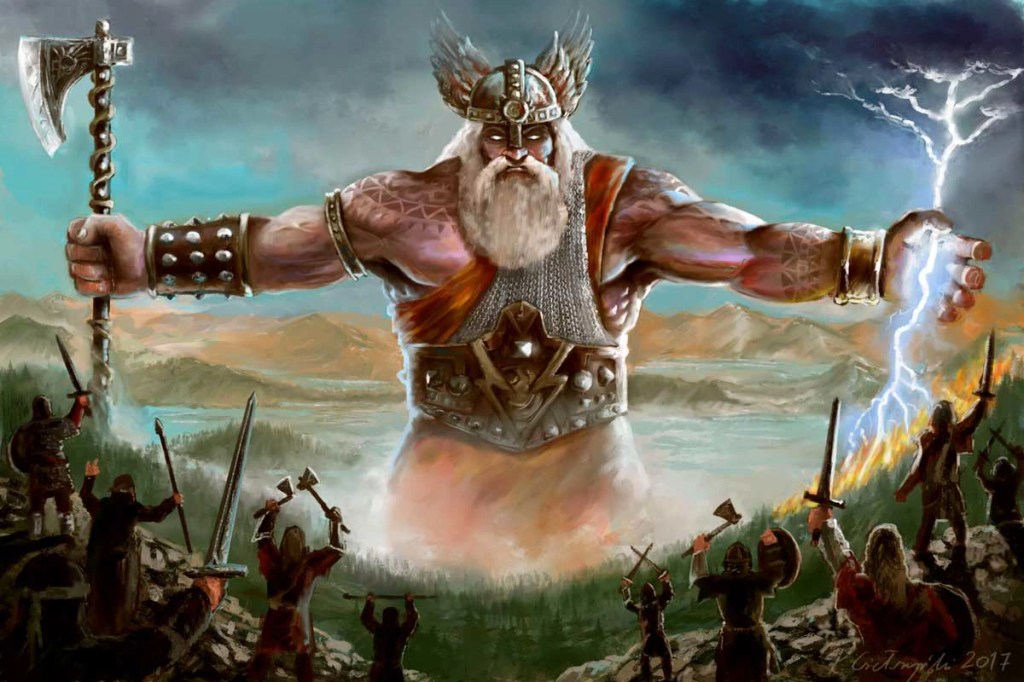
I was always a bit curious about this topic. I must admit that i don’t know much about this. the more i read about it, the more complex it becomes. Information on the religion of the polytheistic Slavic tribes is scarce about Christian missionaries weren’t interested in the spiritual lives of the pagan Slavs. The pagan Gods were called demons by Christian missionaries, a typical strategy used by Christian missionaries to deter locals from worshipping these Gods. However, not all polytheistic traditions go extinct. Some are absorbed into the Christian traditions to make it seem les alien than it was.
Seeing how ancient Slavs rarely wrote anything down, we have no written records and most of our sources, especially written sources are from contemporary Christian missionaries or from sources written down later. However, we do have some information on these Gods because of archeological records. Some scholars seem to have found a kind of dualism in Slavic polytheism, similar to Zoroastrianism was before it evolved into a monotheistic religion. But there is no consensus on this either, and those who assume that such dualism in mythology may have existed, point out that Slavic dualism was probably not as extreme as in Christianity or Zoroastrianism. Some might suggest that the names of Chernobog and Belobog as mere personifications of good luck and bad luck, not as actual Gods that
Some Gods are associated with certain other Gods like Hellenic and Norse.
Perun or Perkunas (for the Baltics) was also associated with Zeus and Thor, because Perun was the God of Thunder, but also sky, lightning, storms, rain, war, law, fertility and oak trees. He is the highest God of the pantheon, so similar to Zeus and Jupiter.
Veles also known as Volos, is a Chthonic god of the underworld, described in contemporary sources as a cattle god, but according to various hypotheses, he had a much broader sphere of influence. His function as protector of cattle may be connected to both wealth and rule of the underworld, which was imagined as a pasture where human souls grazed. Through comparative methods, he can be interpreted as a deity of magic, knowledge, divination, and poetry. As the guardian of the boundary between the world of the living and the dead, he was also a god of the wilderness, hunting and animals. He was also a guarantor of oaths, punishing their violation by “turning them yellow”, most likely a metaphor for a form of jaundice.
His mythological nature and powers are similar, though not entirely identical, to those of Varuna, Velnias, Odin (marginally),Hermes, Afsati and Hades. Reconstructionists speculate that he may directly continue aspects of the Proto-Indo-European pantheon with the original deity Welnos. Veles is one of few Slavic gods for which evidence of offerings can be found in all Slavic nations.
Svarog is the divine smith and God of celestial fire, often seen as the creator God, sometimes associated with Hephaestos/Vulcanus.
Mokos, the “Moist Mother”, Goddess representing fertility, women’s work and protection. Possible associated with Gaia and Rhea, Hera.
Dazhbog, a major sun God, representing abundance and good fortune. Associated with Apollon.
Yarillo: God of spring, fertility and harvests.
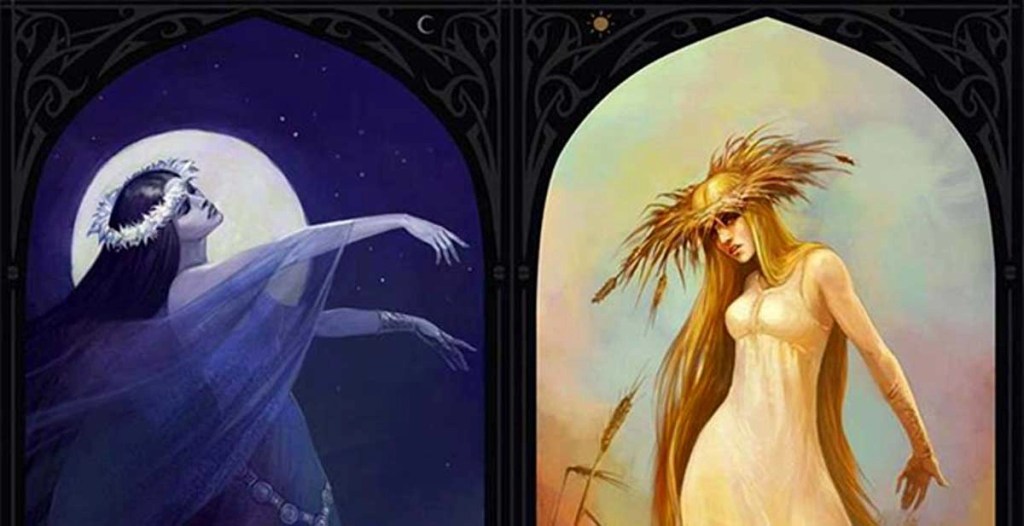
Morana/Marzanna: Goddess of winter, death and rebirth. Possible associated with Demeter, Hekate, one would assume Persephone as well.
Stribog: God of winds, sky and air.
Svetovid/Swetovid: a God of war and abundance. Radogast: God of hospitality and the night sky.
Lada; the Goddess of Love (likened to Aphrodite’s presence)
Vesna; the Goddess of Spring
Živia, the Goddess of Water. However, Živia’s origin predates the notion of Mother Earth.
I must admit that after some research on the net ‘not always a good reliable resource) i’m still puzzled by it. I wonder how Slavic polytheists reconstruct their religion and worship their Gods? If you worship these Gods, feel free to comment on how it is done and what books you would recommend? Im aware that this might be error proned, so if you see any, feel free to let me know?
 Aidonian's blog
Leave a comment