Who is Khronos?
At first glance, people assume I would be talking about the Titan Kronos, but I’m not. Khronos and Kronos are two different Gods. One is a Protogenos, a Primordial God, the other a Titan, King of the Universe and of Gods and men before Zeus took over. Khronos means time. Khronos means Time and is the Protogenos of Time. He is the God of Time. He is described as an old white-haired man with a long Grey beard, who turned the wheels of time (perhaps revolving the heavenly constellations). He was the First Protogenos who was born. Through Him, we know of time and experience it and its effects can be seen throughout the whole universe as it effects everything. Khronos is seen as the personification of Time itself and in most myths, there is a reference to Him nut not to Him but to time itself. He is often mistaken with the Titan Kronos but to some Kronos himself later overshadowed Khronos so that this mistake was often made. Its through this deity that we know of Father Time.
Based on what sources mention him, it seems that He wasn’t mentioned or referred at all earlier than the 6th century BC. Hesiod in his Theogony, which is a very important religious literature, doesn’t mention Him at all or is perhaps at best vaguely implied. Orphics on the other hand do mention Him and He was a important figure. Later on, Khronos and Kronos became one God. This is not so uncommon. For example, Thanatos and Plouton are two distinct Gods, but later people assumed that they were one and the same.
Names
- Aion
- Poros
Except for Orphic cosmology, in Hellenistic philosophical traditions and mystical traditions, He plays no active part in myths and legends. His parents are said to be Hydros and Gaia or none at all. Nonnos’ Dionysiaca mentions that He emerged from creation like most Protogenoi. Other Orphic fragments mention that He was born from the union of Hydros and Gaia. Hydros is the Protogenos of primordial waters. Orphics throughout various works mention that He was the father of various Gods like Khaos, Aither, Gaia, Phanes, Hemera, the Moirai and the Horai. He was said to be the father of Aither, Hemera and Moirai with Nyx. So by putting Him first, they saw Him as the First of all, that Time is a cosmic force that existed before the universe. In these traditions, Khronos is portrayed as:
- Eternal
- Uncreated
- Serpentine or dragon-like
- A force beyond the Olympian gods
- The generator of cosmic order
He is not “time” in the simple sense of clocks or schedules, but primordial duration, the endless flow that allows creation and destruction to occur.
Khronos in Orphi cosmology
In the Orphic cosmogony he emerged self-formed at the dawn of creation. Khronos was envisaged as an incorporeal god, serpentine in form, with three heads–that of a man, a bull, and a lion. He and his consort, the serpentine goddess Ananke (Inevitability), enveloped the primordial world-egg in their coils and split it apart to form the ordered universe of earth, sea and sky. After this act of creation the couple circled the cosmos driving the rotation of heaven and the eternal passage of time.
The figure of Khronos was essentially a cosmological double of the Titan Kronos (“Father Time”). The Orphics sometimes merged Khronos with the creator-god Phanes, and also equated him with the Titan Ophion. His equivalent in the Phoenician cosmogony was probably Olam (Eternal Time) whose name is written Oulomos in Greek transcripts.
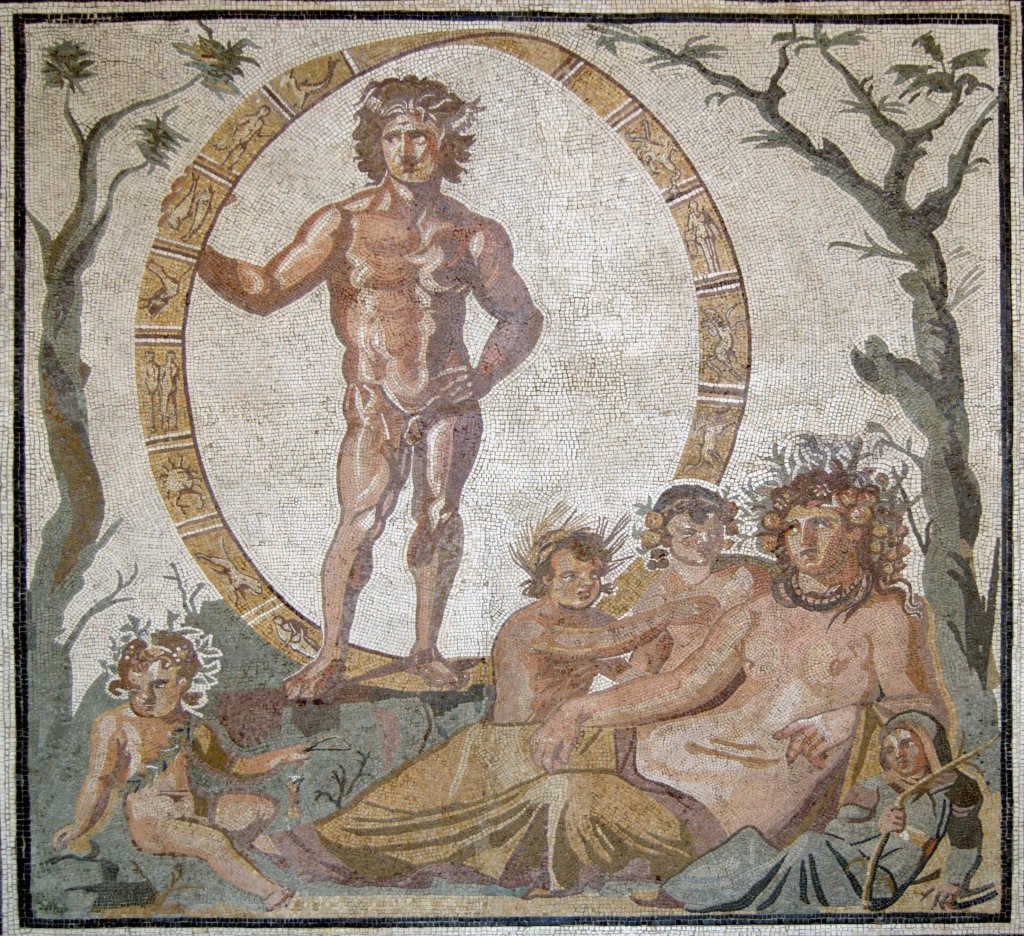
Khronos was depicted in Greco-Roman mosaic as Aion (Aeon), eternity personified. He holds a wheel inscribed with the signs of the zodiac and Gaia (Mother Earth) usually reclines at his feet. The poet Nonnus describes Aion as an old man with long, white hair and a beard but mosaic-art presents a youthful figure.
In the Orphic theogonies, Khronos appears at the very beginning of existence. Unlike Hesiod’s Theogony, where Chaos is first, Orphic cosmology often presents Time and Necessity as foundational cosmic forces.
Khronos is described as:
- self-generated or eternal,
- incorporeal,
- serpentine or dragon-like,
- and associated with endless cosmic motion.
Some Orphic fragments describe him as a winged serpent with:
- a human head,
- a lion’s head,
- and a bull’s head.
This imagery is symbolic rather than anthropomorphic. Primordial deities in Greek religion often represent metaphysical realities rather than “human-like gods.”
Relationship with Ananke
Khronos is closely tied to Ananke, the Protogenos of Necessity, Inevitability, or Constraint.
Together, Khronos and Ananke:
- encircle the primordial cosmos,
- generate or shape the Cosmic Egg,
- and initiate ordered creation.
In Orphic thought, Time and Necessity precede structured reality itself. This is philosophically significant: existence unfolds not randomly, but through inevitability and temporal process.
In Modern Hellenic Polytheism
Modern Hellenic polytheists and reconstructionists interpret Khronos in different ways:
- Some treat him as a literal primordial deity.
- Others view him as a symbolic divine principle.
- In Orphic-inspired practice, he may be honored alongside Phanes, Nyx, Ananke, and other primordial powers.
Modern interpretations often emphasize:
- cosmic order,
- mortality,
- transformation,
- and the sacred nature of time itself.
Khronos also became influential far beyond Greek religion. The idea of “Father Time” in later Western art partially derives from the blending of Khronos and Kronos. The scythe imagery actually comes more from the Titan Kronos than from the primordial Khronos.
Next up is Ananke.
source:
The Theoi Project
 Aidonian's blog
Leave a comment