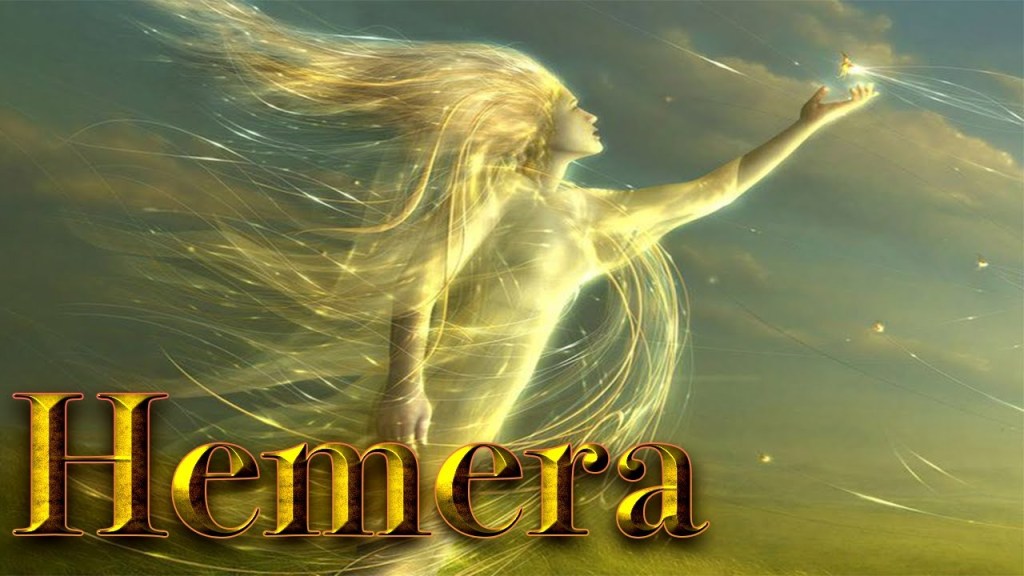
Hemera. Hemera is the personification of the day in Hellenic polytheistic theology. She is the daughter of Nyx and Erebos, sister to Aither and wife to Aither. Every evening Hemera’s mother Nyx drew her dark veil across the sky, obscuring the the shining blue of the heavenly ether (aither), and bringing night to earth. With each morn Hemera dispersed her mother’s mists, bathing the earth again in the light of the ether. In the ancient cosmogonies night and day were actual substances distinct and independent of the sun. The sun ruled the day but was not its source.
Hemera (Ἡμέρα, “Day”) is the primordial personification of daytime in Greek cosmology. She represents the arrival of light and the daily transition from darkness into the visible, ordered world.
As one of the early cosmic beings, Hemera belongs to the primordial layer of Greek mythological thought, where natural realities such as night, earth, sky, and light were understood as divine powers.
Hemera was closely identified with Hera, the queen of heavens, and Eos, the goddess of the dawn. Hesiod seems to regard her as more of a divine substance rather than anthropomorphic goddess. She was largely irrelevant in mythology, with her role being entirely subsumed by the goddess Eos.
According to Hyginus, Khaos is her father, but others like Hesiodos lists Nyx and Erebos as her parents.
With Aither She gave birth to Ouranos (Cicero mentions this) or Gaia, Ouranos, Thalassa by Aither (Hyginus)
It could very well be that at one point in history – this is pure speculation on my part here- that She was worshipped. Simply because Hemera represents the changing of the order, night to day. People knew that through her, they felt the warmth of the sun. Hemera thus represents the living and active portion of existence governed by light. While other religions saw night and day as opposites of each other, the ancient Greeks did not saw this duality between Night and Day. They knew that they were part of the cosmic order, The transition from darkness into activity and life like social order, human action, work, travel.
She was not opposite of Night, because Night was her mother. Night (Nyx) and Darkness (Erebos) gave birth to Light and Day. This creates a cosmic balance between them. As one enters, the other leaves. Rather than enemies, Nyx and Hemera are complementary cosmic forces.
Hemera and Aither
Hemera is also associated with Aither who is her husband.
Aither represents:
- the pure, bright upper air breathed by the gods,
- celestial light,
- and divine luminosity.
Together, Hemera and Aither form a pair associated with:
- brightness,
- clarity,
- and heavenly illumination.
In some later traditions, they are also parents of various cosmic beings, though genealogies differ. They are very different from solar Gods like Helios and Apollon. They are what solar Gods bring to the world.
Its unique to say the least that the ancient Greeks saw these things are separate from each other.
Worship and Cult
There is little evidence of major independent cult worship dedicated specifically to Hemera. Like many Protogenoi, she functioned more as a cosmological principle than anything else.
However, day and light themselves held deep religious significance in Greek life:
- rituals often occurred at dawn,
- daylight symbolized divine order,
- and visibility was associated with truth and civilization.
Hemera therefore reflects the sacred dimension of the daily cosmic cycle. Later on, She was absorbed into Eos, Goddess of the Dawn, daughter to Hyperion and Theia and sister to Helios as to mark the changing of the order and a more clear distinction between the changing of Night to Day.
In Modern Hellenic Polytheism
Among some modern practitioners of Hellenism, Hemera may be honored as:
- the sacred force of day,
- bringer of clarity and renewal,
- or embodiment of the daily cycle of life.
Associations may include:
- sunrise rituals,
- morning prayers,
- mindfulness practices,
- and reflection on cycles of darkness and illumination.
She is often approached as a peaceful and balancing cosmic presence.
She reflects the ancient Greek understanding that even the ordinary passage from night into day was part of the sacred structure of the cosmos itself.
 Aidonian's blog
Leave a comment